

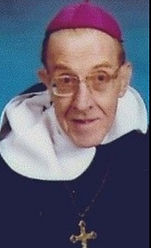


Guérard des Lauriers was born in central France, near Paris, on October 25, 1898. After excelling in his high school exams, he joined the military towards the end of World War I, and later studied mathematics. In 1926, he entered the Dominican novitiate, and five years later, he was ordained as a priest. He subsequently earned academic degrees in theology, philosophy, and mathematics. He served as a professor of philosophy, initially at a Dominican institution in France, and later, during the pontificate of Pius XII, in Rome at the Pontifical University of St. Thomas Aquinas (Angelicum) and the Lateran University. He was also a confessor and advisor to this great Pope, providing the theological basis for the dogma of the Assumption of the Blessed Virgin Mary (1950). Father Guérard also laid the groundwork for proclaiming the dogma of the Universal Mediation of Mary, which was not declared due to the attitude of Pius XII's successors, who prioritized ecumenical relations with "separated brethren" over honoring the Virgin Mary.
During the Second Vatican Council, he advised a group of conservative council fathers associated with the Coetus Internationalis Patrum. He was the principal author of the Brief Critical Study of the Novus Ordo Missae, which was eventually signed by Cardinals Ottaviani and Bacci. In 1970, he was dismissed by Montini (Pope Paul VI) from his teaching positions at Rome's theological faculties, after which he taught at the seminary of the Society of St. Pius X in Écône. Father Guérard des Lauriers, drawing on the writings of prominent theologians, mainly from the Dominican school, formulated the sedeprivationist hypothesis. This theory posited that Paul VI, by falling into post-conciliar heresies, lost jurisdiction over the Universal Church. The distinction between a material pope—who occupies the papal throne and holds administrative power—and a formal pope—who possesses the authority of the Keys of St. Peter—sets sedeprivationism apart from sedevacantism, which assumes the permanent loss of office by a heretical pope. In contrast, a material pope according to the Guérardian view could convert and thus gain the full power of the papacy.
The questioning of Paul VI’s papacy and the validity of the post-conciliar sacramental rites was not accepted by the Society of St. Pius X. Due to these differences, in 1977 Archbishop Lefebvre ended Father Guérard's collaboration with the Society, and when John Paul II became pope, Lefebvre softened his stance towards the post-conciliar Church.
Unsure of the future position of the Society of St. Pius X, and to ensure apostolic succession among Latin-rite Catholics, Father Guérard des Lauriers OP received episcopal consecration on May 7, 1981, from the sedevacantist Catholic bishop Pierre Martin Ngô Đình Thục. In response, the Congregation for the Doctrine of the Faith, acting under the 1917 Code of Canon Law, declared an excommunication penalty on the bishops involved in the ceremony, both those conferring and those receiving consecration. It is noteworthy that the Code of Canon Law promulgated by John Paul II in 1983, which came into effect on November 27 of that year, altered the ecclesiastical penalties for episcopal consecrations carried out without a papal mandate, including provisions for such actions in cases of fear prompted by greater necessity. Under the 1917 Code, "illicit" episcopal consecrations could not take place: Catholics could either follow the post-conciliar hierarchy or fully reject obedience to it.
Bishop Michel Louis Guérard des Lauriers OP died at the age of 90.

