

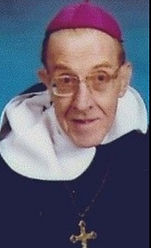

Sermon of bishop Donald Sanborn
- Last Judgment.
Date : november 2025.
In the name of the Father and of the Son and of the Holy Ghost.One might wonder why God has appointed that there be a Last Judgment, a second judgment after the first one has taken place when we die and the eternal lot of the soul is already determined. St. Thomas Aquinus says that the reason for the Last Judgment is that judgment cannot be perfectly given concerning any action until the action is complete in itself and all the results of the action have taken place. For example, in medicine, judgment cannot be made concerning the value of a medicine unless all of its effects are detected. The effects of a man's life cannot be perfectly judged at his death since these effects have not all taken place. The effects of a man's life happen in the following ways.

Bishop Donald Sanborn
First, a man's life lives on in the memory of the living. In this case, good or evil reputations live on sometimes falsely. See how many people who have been evil in the past are held up as great heroes. There is need therefore for a final judgment in which to set straight the reputation of all. Secondly, a man's life lives on in a certain way in his children who are something of the parent. Therefore, judgment must be rendered concerning how the children have been raised. Yet it remains true that evil parents can have good children and good parents can have evil children. Parents will be judged therefore not on the sins of their children which they did not contribute to, but only on those sins in which they had a part through bad upbringing and bad example as parents.
Thirdly, men will be judged on the long-term effect of their actions. Henry VIII, for example, has caused 500 years of sin. We just saw recently that a woman was made the Archbishop of Canterbury, something that probably would make even Henry VIII roll his eyes, and the effects of his sins will probably continue until the end of the world. This is the heresy of Anglicanism and all that that has brought with it. Conversely, the preaching of the Apostles continues to have an effect even to the present day and it is fitting that they should be rewarded for the good effects of their zeal. In a fourth way, the disposition of each man's body must be met with justice. Sometimes the wicked have been buried with honor. It's very common and the good have been treated with shame. In some cases, the bodies of martyrs have been left to the dogs. All of these things must be righted at the final judgment.
The emperor, the Roman emperor Tiberius, who was the the emperor during the time of our Lord's death, was so cruel and very very suspicious that if there was anyone that opposed him in any way, he would be put to death and his body would be thrown in the Roman forum just to rot there. And if any of his relatives or friends came to take care of the body or mourn the deceased person, they would also be put to death. So they treated martyrs in very in very much the same way. Fifth, man must be judged concerning those things upon which he has set his heart, some of which last a long time. Thus, a man that has set his heart on obtaining a large amount of money must be judged on the effects of that amassing of money, whether good or bad. If he amassed it for a holy purpose and was generous to the church and to the poor, that's good.
If he amassed it simply to entertain himself and to be insensitive to those who are in need, that's bad. Now ,let us pass to an examination of the Final Judgment itself. How will it take place? St. Thomas Aquinas describes the Last Judgment in the following way. He says, first Christ will appear in the Heavens and assemble before himself all mankind, billions and billions of people from Adam right down to the last human being. Thus our judgment will take place in the presence of all. He will speak, says St. Thomas, of the greatness of His passion and show all the instruments of His death. He will show the wounds which He suffered for love of us. For now will be the time of the vengeance for His having been put to death. And for all of those who died unrepentant in the state of mortal sin. In the Apocalypse, it says, "Every eye shall see Him, and they also that pierced Him, and He was clothed with garments sprinkled with blood." Christ will then accuse the sinner by his wounds and His death will cry out for justice. This will be the time of the balancing of the scales.
No longer the time for mercy, but the time for justice. In the second place, there will be a discussion of the omissions of good works which we should have performed. In St. Matthew, it says concerning the Last Judgment, "I was hungry and you gave Me not to eat. I was thirsty and you gave Me not to drink. I was a stranger and you took Me not in. Naked and you covered Me not, sick and in prison and you did not visit Me. Thirdly, the evil thoughts of the sinner shall be looked into and judged. The evil thoughts. In the Book of Wisdom, it says, "Inquisition shall be made into the thoughts of the ungodly." Next, there will be an examination of intentions of the heart. After this, we shall be judged concerning sinful words. St. Matthew, in St. Matthew, it says, "Every idle or sinful word that men shall speak, they shall render an account for it on the day of judgment."( idle or sinful words). Next, our evil actions will be examined.
Wisdom says, "The Lord will examine your works and search out your thoughts." After this, we will be judged on how we used our things. As it says in the gospel, "Rend an account of thy stewardship. For everything you own must be used ultimately for the glory of God." Following this, we shall be judged on how we cared for our family, not only in a temporal manner, but more importantly in a spiritual way. Finally, we shall be judged on the use of our time. In Job, it says, "God has given to man time and place for penance, and he abuseth it unto pride.’’ St. Thomas also says that the accusers against the sinner will be three. The first is man's own conscience. In his epistle to the Romans, St. Paul says, "Their consciences bearing witness to them and their thoughts between themselves, accusing or also defending one another on the day in which the Lord will judge the secrets of men's hearts." The second accuser is the devil who is man's tempter and who continually observes our activities, continually.
The third set of accusers will be the places in which man has sinned and the persons with whom he has sinned. In the book of Habakkuk it says ‘the stone shall cry out of the wall and the timber that is between the joints of the building shall answer”. Father will accuse his own son and a son will accuse his father. Sons will reproach their fathers for bad example, the reason for which they themselves are now being condemned. In Wisdom, it says, "For the children that are born of unlawful beds are witnesses of wickedness against their parents in their trial.” In addition to these three accusers, there will be three witnesses. The first is the Creator whom we have offended. In Jeremias, it says, "Because they have committed adultery with the wives of their friends and have spoken lying words in My name, which I commended them not to do. I am the judge and the witness, seth the Lord.” The second witness will be the Guardian Angel, who is sent to protect each man. He will bear witness against the sinner for much ingratitude.
The third witness will be the stain of sin which will be apparent on men's faces. In Jeremias, we read, "Thy own wickedness shall reprove thee, and thy apostasy shall rebuke thee." Now, this is the Last Judgment of the sinner, someone who dies unrepentant in the state of mortal sin. And while that is something filled with dread for him, at the same time it will be a glorious day for those who have loved God. For in it they will be vindicated before all mankind. All evildoers who have not been punished in this life will be exposed to all and eternally punished. Persecutors, and oppressors will finally meet with ignominy and disgrace. Those who have sent martyrs to their excruciating deaths will then be denounced, condemned, punished in accordance with their crimes. The scales shall be forever balanced, and the glory of God forever set a rightight. No more shall evil be tolerated, but the cockle shall be pulled up and set on fire, and the wheat shall be gathered into the barn. After the Last Judgment, no human being shall be again conceived.
The human race will be at an end. Sin shall disappear from the universe and each creature of God will have received his just due, each according to his works. We have nothing to fear from the justice of God. Therefore, if we are without sin, we can see, however, from what has been said that it is important to make up for the damage of past sins, lest this damage be held against us at the Last Judgment. That is known as temporal punishment due to sin and it is one of the reasons for a sentence of purgatory. However, there is no purgatory after the Last Judgment. So, we will not be judged for things which lie beyond our control. And that's very important because many things do not lie within our control. But we will be judged for those effects which we were able to repair. So if you have raised your children badly, do your best to repair the damage of that bad raising. And the we should do penance for those evils which we were able to prevent and we must do our best to undo those evils. We should also resolve to use our time wisely and not to spend it frivolously on excessive entertainments.
St. Alphonsus Liguori took a vow never to waste time. Time is a precious thing which must be used ultimately for the glory of God. And the way we glorify God is to do His will. And there's always a will of God for us at every minute of the day. It most of the time it's our duties of state in life, but it could also be a recreation or a rest. All of that is part of what God wills for us and to the best of our ability we should try to determine what is the will of God, that is ,what is in accordance with reason. But we should never waste time on silly, stupid things because time is given to us for a very good reason and that is to work out our salvation to glorify God. So typical ways in which we waste time would be addiction to sports. Not sports in themselves but addiction to sports where all you can talk about and think about is sports. That's a sign of waste of time. Or dirty pastimes, bad movies, etc. bars, present day media, movies, but to spend it on the glory of God, that is the fulfillment of our duties of state and life is what we should be doing. The contemplation of the things of God, the building up of his church, the salvation of souls, that is always the will of God. We know not the day nor the hour.
The Catechism of the Council of Trent mentions three things which must be fulfilled before the Last Judgment. The first is the preaching of the gospel to the whole world. The second is the general apostasy from the faith of which St. Paul speaks in his second epistle to the Thessalonians. And the third is the coming of the Antichrist. Number one and number two have taken place already. And when this book was written in the 1500s, none of those three things had taken place. And so we're waiting for the antichrist. And certainly this age in which we live could easily produce one. It is in a certain way pregnant with the Antichrist. Very easily it could produce it. And you can see a tendency to globalism and for example, climate change fanaticism. All of that is a way in which they ultimately establish a world order, a world government which will involve socialism and obviously the repression of any religion that is not in conformity with the ideas of the world socialist government. And that will be the reign of the Antichrist. There will be some personality. We don't know who it is but you can easily see the preparation for it, especially Leo who can talk about nothing else, it seems, than climate change and peace in the world and various other globalist agendas and make that the purpose of religion.
He said there is hope, the expectation of a a perfect world, a world in which everybody gets along, etc. I'm paraphrasing him, but as if the purpose of the church were to produce something like that, the purpose of Christ's coming were to produce a perfect world. The world will never be perfect. For as long as there is original sin and its effects, it will never be perfect. And that is not the purpose of the church. ‘ My kingdom is not of this world. For this I came into the world to witness unto the truth, and those who are of the truth hear My voice.” Now, whatever the time of the Last Judgment should be, we know that it will come. Let it be a reminder to us to live our lives every day with the same scrutiny which they will receive on the last day. And while we're talking about the Antichrist and this general period that we're in, I thought I would add to this sermon something that was written by Cardinal Billot. Cardinal Billot was a great theologian, who lived at the time of St Pius X. He died in the 1930s and he was actually asked by St. Pius X to write one of the drafts for the encyclical against modernism. St. Pius X did not take his, he took someone else's but, nonetheless, it shows that he was greatly honored by St. Pius X and he wrote an interpretation of the Apocalypse, which is talking about the seven letters to the seven churches. It's in the first three chapters of the Apocalypse.
And even in the 17th century, there was somebody who said the seven churches are not actually the dioceses of these various cities, but seven ages of the church from the beginning right to the end. And cardinal Billot says that we are in the period of Sardis. See, there's various cities that are mentioned and we are in the period of Sardis. Now listen to what he says. Sardis was indeed the famous city of Lydia in which Croesus reigned. Croesus was known for his wealth. It evokes the thought of the abundance of gold and silver of a love immersed in the riches of this world. A love of luxury and of material prosperity. Now, the cardinal wrote this in 1929. This period of Sardis goes from the French Revolution until the coming of the Antichrist. For this reason, he says, those things which regard the period of the church are seen to be in a downhill state. Everywhere there is apostasy, everywhere defection. And while most will recede from religion, there will be a few who will preserve the faith. It's like a prophet. How in 1929 anyone would say that about our age? In 1929, the church was flourishing as if as it never had before. He quotes the Apocalypse. There are few names in Sardis which have not defiled their garments. Meaning few who have remained faithful. And again he h quotes, "Thou hast the name of being alive and thou art dead." That's what the the letter to the angel of Sardis says in other words to the church of Sardis. ‘Thou hast the name of being alive and thou art dead”. The name of being alive. This is Cardinal Billot commenting.
The name of science, the name of liberty, the name of civilization, the name of progress, and you are dead, sitting in the darkness and the shadow of death, because you have rejected the light of life, which is Christ the Lord. For this reason it is it said to the angel of the church of Sardis, "Be watchful and strengthen the things that remain which are ready to die." That's verse two. And it is commanded to the church of Sardis in the most emphatic way. This is the cardinal. That it remain unwavering in regard to those things which have been handed down by the Apostles without receding from the meaning which the fathers held for some pretense, a name of a higher understanding. And he finishes by quoting verse three. ‘Have in mind therefore in what manner thou hast received and heard and observe and do penance.”
In the name of the Father and the Son and the Holy Ghost. Amen.

