

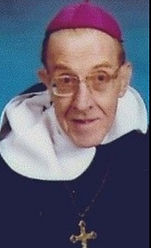

Sermon of bishop Donald Sanborn
- Leo XIV.
Date : may 2025.
In the name of the Father and of the Son and of the Holy Ghost.
Amen. Today I would like to speak to you about Leo XIV. It's important that you understand certain things about him and also some of the reaction to him. The novus ordo conservatives as we call them are in ecstasy and euphoria over the fact that they think of him as some kind of a Catholic. Recently he said that the civil power should promote family life which consists of a stable union between man and woman. Well, that was just so wonderful for them because he did not support sodomy. And here, do we have to rejoice that someone who is supposedly a Roman pontiff does not support sodomy?

Bishop Donald Sanborn
Is that where we are? So, they're all in in ecstasy that he said that. In fact, he left out the fact that a valid marriage is what is a family, not people who are stably united. You could say that about people living in concubinage or in an invalid marriage where there's divorce and remarriage. That's a stable union, but it is not a family because a valid marriage is not present there.He chooses his words very carefully, I notice, and he is more intelligent than Bergolio was and he's smoother and more cautious than Bergolio was and I think that he is giving an impression of a certain amount of, you might say ,conservatism.
It's all false. He is a thoroughgoing modernist. And you have to understand that. And just I want to give you a little background. My sermon might be a little long today, but I think this is important. A little background on modernism in general. It started actually with the Renaissance. See, the idea of modernism is that the modern world has become something quite different from the medieval world. And therefore the church must conform itself to this modern world to what we call modernity in order to survive. So there has to be a transformation of Catholicism retaining always the same institution. See so the institution survives but the religion in it is all changed and it is in constant evolution.
That is the modernist idea that as people change and their attitudes change, their customs and morals change, the church must change with them. You must understand that. And so with every modernist pope that is elected, we think, well, what is he going to do to the church? That was never true before Vatican 2. There was never any question of changing anything essential in the Catholic Church. You wouldn't even think about it. It's not like a political party where the Democrats get in and the Republicans get in. This is all new. And I just want you to be aware of that.
So the Renaissance emphasized man without original sin, man as man, without original sin, without having to order his life in such a way as to look forward to the next life and to suffer here in union with our Lord on the cross. That was embedded in the minds of the medieval people. But the Renaissance threw that off. With time you had in the 1600s and 1700s the problem of unbelief. You had the Protestant Reformation which instilled in people's minds subjectivism. Free examination of the scriptures. So you take up the scriptures and you decide by the inspiration of the Holy Ghost what it means.
Well, you know what happened that there are so many people there , as many “holy ghosts” so to speak as there are people, as there are protestants because each one believes something different. And so that led to subjectivism that it doesn't matter what you believe. Your dogmas don't matter. What matters is that you have a certain sentiment about God, a certain hope and trust in God. That's faith for the Protestants. That became embedded in Catholic Europe. Then you had the period of unbelief where people who were thinking, especially in England, people who were intelligent, thought, well Protestantism doesn't make any sense and it doesn't.
So they actually fell into a deism where God is someone who created the world and then He has no care of it and we have no care of Him. He , in a sense ,he wound up the clock and walked away and so we don't have to conform ourselves to morality and his laws. He doesn't care. That's known as deism. George Washington was a famous deist and many of the other 18th century people involved in the American independence were deists. It all came from England and that went to Catholic France during the 18th century and you had Voltaire and others who actually spread it out and developed it. Then came the French Revolution where you had the dethronement of Christ in a Catholic country. The establishment of religious liberty and religious indifferentism.
Religious liberty meaning that it the state will be completely indifferent to whatever religion you want. And this is extolled as something very wonderful and great. As a matter of fact, it is condemned by the Roman Catholic Church. Our Lord came to teach the truth. He said to Pilate, when Pilate said, "Art thou a king?" He said, "Thou sayest it, I for this was I born and for this did I come into the world in order to witness unto the truth." So he is a king of truth. And as Cardinal Beau, a famous anti-modernist theologian from the time of St. Pius X said, "What kind of God would not require us to believe the religion that he has revealed?" So the idea that you have a right to believe whatever you want with regards to religion is totally false and it is a dethronement of Christ.
Then you had as a result of that the secular state the indifferent state, the state that is completely lay in the sense that it has no religion whatsoever. That was very typical in Europe where all the states eventually became secularized and also the promotion of freedom of speech and freedom of the press which again are held up as great things. There is a true freedom of the press and true freedom of the of speech and as much as it is legitimate to say true things that other people may disagree with , but error has no rights. Pope Pius XII said that error has no rights and therefore the church has always condemned freedom of speech in the sense that you can say whatever you please.
You could blaspheme our Blessed Lady and our Blessed Lord if you want, under freedom of speech that is condemned by the Roman Catholic Church. As well as freedom of the press that you can print whatever you please. But these are things that are entrenched now in what we call modernity. So you have to understand that about modernism. Then came in the 19th century with Darwin evolutionism. Another ingredient in this ugly and very distasteful cake known as modernity. Another ingredient in there. Liberal Protestantism in the 19th century where they said everyone has an experience of God within himself but we know him differently and we express him differently. That was Schleiermacher in the 1820s 1830s.
So that came in and that eventually affected many Catholics, Catholic theologians. That idea that religion is something entirely interior that there is no external revelation, no revelation that is proposed by means of dogma in the Catholic Church. It's all interior. It's what you feel. It's what you think.
So then , so the Catholic Church always opposed this modernity. It saw it as hostile to Catholic civilization, to the Catholic Church itself, was constantly condemning it and opposing it. But the modernists came along and said, well, the church won't survive unless it adapts to the modern world. So you had the emphasis on the religious experience that is dogma doesn't matter. Whatever you feel about God is true for you and this is also due to the rise of what we call subjectivism , that something can be true for you but it's not true for me . That's subjectivism - it comes from the famous philosopher Immanuel Kant but he was only really expressing something that was commonly held at the time. So the religious experience fits perfectly into that. I have my experience of God and you have yours.
That's a capital principle of modernism. Evolution of dogma called by St. Pius the X a heresy and a monstrous error and that is that dogma as I told you, must change as the human race changes in its attitudes. All right. Ecumenism which is the obvious conclusion because if we all have the right to believe whatever we want and dogma is not objective and it evolves, well, then we should all just get together with some common denominator like World Council of Churches - Christ is the Lord, but everything else is up to you.
You can believe whatever you want that is ecumenism and ecumenism is the enemy of dogma because you cannot insist that somebody believe something they are not willing to believe. So you can't say to the protestant you must become a Catholic in order to be saved. You can't say that because as Vatican 2 says non-Catholic religions are means of salvation. So why become a Catholic? And then you have the part of modernism that the church is at the service of mankind. The Church does not exist for them for the salvation of souls but it is at the service of mankind and world peace.
That's why you see their concerns about immigration and climate. Bergolio was practically incapable of saying anything pious. It was always something about the Palestinians or the Israelis or some sort of conflict someplace. And yes, while the church would always want to see peace, nonetheless, that is not its primary function. Its primary function is the salvation of souls, the preaching of the gospel, saying of Mass, distribution of the sacraments. It is not to worry about climate. And certainly, it has no place to dictate the governments concerning their laws, concerning immigration. It is not the place of the Catholic Church to do that. “My Kingdom is not of this world”. Our Lord said to Pilate and there are many reasons for immigration laws. When we want a priest, for example, to come into this country and work here, we have to pay lawyers a lot of money to process them. And it takes years and years. Bishop
Fliess became an American just the other day, but we started with him about eight years ago. And then father Sevedra told me his brother could not get a visa three times from the embassy in Mexico. Why? Because they felt that he didn't have a reason to return to Mexico. So you see how difficult it is. The laws are very strict. And so and there are reasons for that. The Church has no business telling nations that they should open their doors to immigrants. And their idea is social gospel. The Church is here to make earth a paradise. So you have to understand this about the modernists and then its goal is dogmaless humanitarianism. You see, get rid of the dogmas. Dogmas don't matter. They don't count. And the church has this role to make the earth a better place in which to live.
So Vatican 2 was embracing modernity instead of the church's constant opposition to modernity. It flipped with Vatican 2 and now it is embracing modernity. All of these things that I just explained to you. And there are four great heresies in Vatican 2. The first - is making a distinction between the church of Christ and the Catholic Church. That is a heresy. They are one and the same thing. There is no big Church of Christ and then the Catholic Church. That's the first heresy. Collegiality, which is the democratization of the church, which is absolutely important for them to dethrone the pope and make him something like a British monarch, some sort of overseer and great white father.
Ecumenism - where it says false religions are a means of salvation that is a heresy. There is no means of salvation except the Roman Catholic Church. Religious liberty which is the primacy of conscience over revelation. God revealed a religion. He died on the cross. He came down to us to witness under the truth. All humanity must accept that truth. Religious liberty says you have a right to reject that. That's a blasphemy, blasphemous heresy. Always condemned by the Roman Catholic Church. So the famous priest in the 19th century Lamennais, who ended up apostatizing, he said that the church must seek the temporal happiness of mankind. It cannot be concerned about the salvation of souls. So that's how far back it goes. It has deep, deep roots.
So I'll and I'll give you some examples of this from this Leo 14; he said: “Brothers and sisters I would like that our first great desire”, he said this just today, in Rome, “first great desire be for a united church a sign of unity and communion which becomes a leaven for a reconciled world”, again he wants unity in the Church for a purpose of some worldly peace. Everything is ordered to that. He says-“ it is never a question of capturing others by force, by religious propaganda or by means of power. Instead, it is always and only a question of loving as Jesus did”. Now, religious propaganda, it is true that the church never wants to force anyone to be a Catholic. Religious propaganda.
That word that comes from the congregation that was founded in the 19th century I believe or 18th century the Propaganda Fide, that means the Congregation for the Propagation of the Faith in English. It became a bad word because Goebbels, the Nazi minister, who was a Catholic or raised a Catholic anyway, took it for his promulgation of Nazi ideas and it was known as propaganda, because he knew the term and now it has sort of bad meaning. But for him to use it that way?
What is religious propaganda except the preaching of the gospel, going out and teaching all men as our blessed Lord said. How is that different and remember Bergolio said “ proselytism is solemn nonsense” and proselytism means you go and you say to a non-Catholic you are in the wrong religion you need to convert to the Catholic faith and expose to him the reasons why he should convert. That is proselytism. That is the propagation of the faith. The church has always done that. It went all over the world, India and Japan, St. Francis Xavier in order to bring people to the faith because the faith is the source of salvation. He's saying none of that.
It's by love that we're going to convert people. And this love is not a supernatural charity. There is no supernatural charity without supernatural faith. St. Pius X shortly after his election in 1903 was talking to the cardinals and he said there is an idea of charity without faith, that there can be some sort of love that is in some way going to unite people and be pleasing to God, that is without faith. And he said - charity without faith is a monstrous error because the Church is held together, by faith primarily, it is also held together by supernatural charity. Both faith and charity are supernatural virtues infused by God.
That is not something natural. Natural love will never get you to heaven. You do not go to heaven for being naturally good. You go to heaven for being supernaturally good by means of supernatural faith, supernatural hope, and supernatural charity. He said, "For our part, we want to be a small leaven of unity, communion, and fraternity within the world. (It's always the world). We want to say to the world with humility and joy, look to Christ. Come closer to him." Notice he doesn't say, "Embrace the Catholic faith”. Instead –“Welcome His word that enlightens and consoles. Listen to His offer of love and become His one family. In one Christ we are one”. Now watch. “This is the path to follow together among ourselves but also with our sister Christian churches”. In other words, heretical churches. Heretical groups.
They're not even churches, just groups of heretics, the Lutherans and the Episcopalians, “our sister Christian churches”. They're not sister Christian churches. They're not even churches. There's one Church. Next-“ With those who follow other religious paths, Islam, Buddhism, and with those who are searching for God”, of no religion, but they're searching for God, “with all women and men”. Notice the order there. “With all women and men of goodwill in order to build a new world where peace reigns”. This is perfect modernism. The church at the service of a worldly improvement. Perfect modernism. I just want to point that out to you because he is a sugarcoated modernist.
He is smoother than John Paul 2 and smoother than Ratzinger. Don't be deceived by this man. He's thoroughly modernist. He said, "With the light and strength of the Holy Spirit, let us build a church founded on God's love, a sign of unity, a missionary church that opens its arms to the world, proclaims the word, allows itself to be made restless, restless by history, and becomes a leaven of harmony for humanity." The same theme all the time. The church at the service of humanity as if it's going to make a better world. It is not here to make a better world. “Together as one people, as brothers and sisters, let us walk towards God and love one another”. No mention of Catholic faith, just a love fest of naturalism.
He said, "No one is exempted from striving to ensure respect for the dignity of every person, especially the most frail and vulnerable, from the unborn to the elderly, from the sick to the unemployed, citizens and immigrants alike”. So the reason for our morality with regard to these people is the dignity of every person. Abortion is wrong not because of the dignity of some person but because it is against the law of God. It is murder of an innocent child and you go to hell for it. It is not because of the dignity of the of some person. Do you think that a young girl contemplating an abortion would say, "Well, maybe I shouldn't have one because the of the dignity of man." Do you really think that she would be in some way turned away from that because of the dignity of man?
This is all naturalism. He said, “It is the responsibility of government leaders to work to build harmonious and peaceful civil societies. This can be achieved above all by investing in the family founded upon a stable union between a man and a woman”. And I already told you about that. A stable union can mean a lot of things. Valid matrimony. Even among Protestants, there are valid marriages. Valid matrimony. That is a family. Otherwise, you have people living together and they have merely offspring. But that's not a family. And I'll leave you with something St. Pius X said.
He said, "Strange indeed and both sad and terrifying are the audacity and rashness of spirit of men who call themselves Catholic and dream of founding a society anew in such conditions and of establishing upon earth independently of the Catholic Church”, and he had no idea what would happen to the Catholic Church, so really he means independently of the Catholic faith, “the reign of justice and love”. So they want the reign of justice and love independently of the Catholic faith.
That's Leo, “ with the help of all who come of whatever religion or none at all with or without beliefs, provided only that they are prepared to forget that which divides them”, straight out of the modernist textbook,” their religious and philosophical beliefs, and to concentrate on what unites them, a generous idealism and certain moral forces of whatever origin. It is frightening the result of such promiscuity of labor, the beneficiary of such cosmopolitan social action, can only be a democracy which is neither Catholic nor Protestant nor Jewish. A religion more universal than the Catholic Church, uniting all men, thus finally become brothers and comrades in the “reign of God””. This is what he says about that. “To work no longer for the church but for mankind “ this he says is organized apostasy.
In the name of the Father and the Son and the Holy Ghost. Amen.

