


SERMON
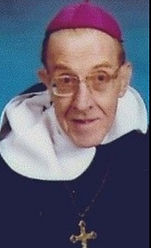
Bishop Charles McGuire
"St. Hermenegild i Arianie"
In the name of the Fr, and of the Son, and of the Holy Spirit. Amen.
One of the actions attributed to the Holy Spirit, because creation is attributed to the Father, redemption to the Son, and certain actions to the third Person of the Trinity, is teaching us, teaching us all things. So, in Catholic schools before Vatican II and even today in our traditional Catholic schools, we invoke the Holy Spirit before classes, and in seminaries, for example, in our seminary, the Holy Spirit is always invoked in this beautiful prayer: 'Come, Holy Spirit, into the hearts of Your faithful...' and so on. So, the Holy Spirit will enlighten our minds so that we can understand and accept all truths,
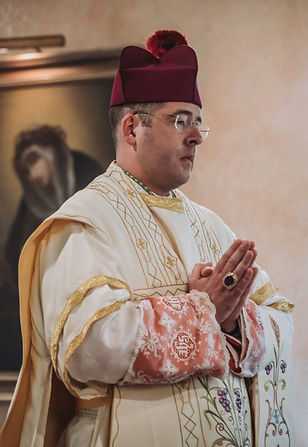
Bp. Charles McGuire
whether natural or supernatural. The Holy Spirit will help us understand all of this. A third action attributed to Him is our sanctification, which is why He is called the Sanctifier. Before approaching any sacrament or opening a holy book for our edification, we should invoke the Holy Ghost, for these are among the many means for our sanctification. To sanctify our souls, we need the sanctifying grace of the Holy Ghost. Throughout the Church's history, the Holy Ghost has raised up people to inspire the faithful, tailoring their example to specific periods of the Church’s existence. To spread the faith and sanctify humanity, the Holy Ghost chose the Apostles to initiate the faith after Christ taught them. It was their responsibility to disseminate the faith among the people. The Holy Ghost selected these 12 Apostles to act in their time, not another.
For instance, during an era when faith waned, He raised St. Charles Borromeo, who reformed many Church disciplines. As religious fervor cooled, St. Charles emerged and instituted formal seminaries, which did not exist before him. When missions required extraordinary evangelists, the Holy Ghost raised two great missionaries: St. Ignatius Loyola, founder of the Jesuits, and St. Francis Xavier, one of history’s greatest missionaries, who baptized thousands, including an estimated 7,000 people personally. To this day, the relic of his right arm, which baptized those souls, is a treasured symbol of the Church.
Today, I want to speak about a saint raised by the Holy Ghost around the 4th century: St. Hermenegild. His feast is celebrated on April 13th. Though little known, he was a great defender of the faith. St. Hermenegild, originally an Arian, was converted by the holy Bishop Leander, whose preaching immediately brought him to the true faith. His father, however, remained Arian and attempted to coerce him to abandon the Catholic faith. Yet St. Hermenegild remained steadfast and was ultimately imprisoned by his father, who was a king at that time. While in prison, his father sent an Arian bishop to him with the Blessed Sacrament, offering him reconciliation if he received Communion from the bishop. Although the Arian clergy had valid holy orders and could consecrate the Eucharist, St. Hermenegild refused to receive the Sacrament from a heretic. His refusal to accept the Eucharist from the Arian bishop cost him his life, and he became a martyr for the faith.
This is a crucial lesson for us today because history repeats itself. We see striking similarities between the Arians and the Catholics of the Novus Ordo. Most Arians were once Catholics or were born into Catholic families. When Arianism spread, entire parishes defected, abandoning the Catholic faith for heresy. They took with them churches, basilicas, and chapels, just as the Novus Ordo has done. Today, many who claim to be Catholic belong to the heretical Novus Ordo religion, including much of its clergy. Both Arianism and the Novus Ordo superficially resemble Catholicism, which is what makes them so dangerous. Arian churches retained their traditional vestments, chalices, monstrances, and liturgical forms, making them appear Catholic.
Similarly, the Novus Ordo often features traditional Latin Masses under Motu Proprio, Gregorian chants, and ornate ceremonies. Yet, like the Arians, they lack the most essential element: the true faith of Christ. Returning to St. Hermenegild’s story, he could have reasoned that receiving a valid sacrament from the Arian bishop was acceptable since true Catholic clergy were unavailable.
However, he recognized that accepting the Sacrament from a heretic would be a betrayal of the faith. His example teaches us that Catholics must never receive sacraments from heretics or schismatics unless under threat of death and no true clergy are available. This principle applies even to the Latin Masses offered by the Society of St. Pius X and other indult groups associated with heretical modernist authorities. Objectively speaking, it is a mortal sin to participate in these Masses, even if they appear valid and reverent, because they are in communion with heretical teachings. The solution for our difficult times is fidelity to the true Catholic faith. Catholics must reject Vatican II and remain loyal to the unchanging teachings of the Church.
The Holy Ghost continues to raise faithful clergy and laity to preserve the faith. Let us perform penance, pray the Rosary an unfailing weapon against heresy and above all, stay true to Catholic doctrine. Only by adhering to the faith taught by Christ can we avoid the path to eternal damnation.
Let us pray for the intercession of the Holy Ghost and Our Blessed Lady to guide us, strengthen our faith, and give us the courage to die for it if necessary. May God bless you.
In the Name of the Father, and of the Son, and of the Holy Ghost. Amen.

